Tallor

Turn overdue invoices into collected cash

Tallor pulls in every overdue invoice from your own finance inbox, reads the replies, and escalates only what a person needs to see.

app.tallor.io/overview

Days sales outstanding

58 → 37

Agent activity

Invoices in

  • Stripe
  • QuickBooks Online
  • Xero
Tallor

Reminders out

Your Google Workspace

finance@yourcompany.com

Read-only on every ledger. Tallor never creates an invoice, and no money moves through us.

You already invoiced. The cash still sits there.

Chasing an overdue invoice is a dozen small jobs: check what is owed, write the email, read the reply, decide if it is a real dispute, remember to follow up. Nobody has time for all of it, so cash ages in a spreadsheet.

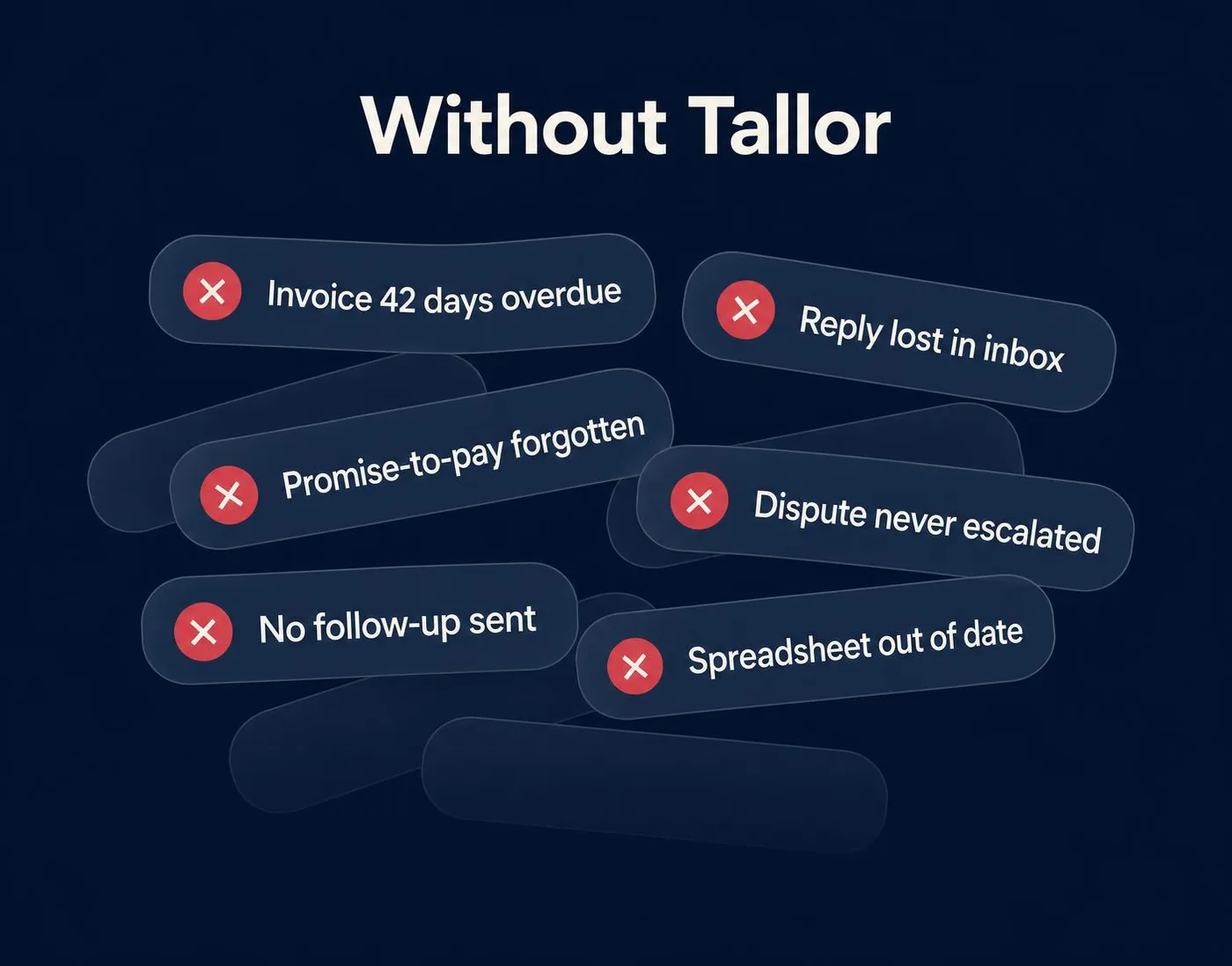
Scattered, overlapping alerts showing missed invoice follow-ups without Tallor
Signals arrive everywhere, get read by no one, and nothing happens.
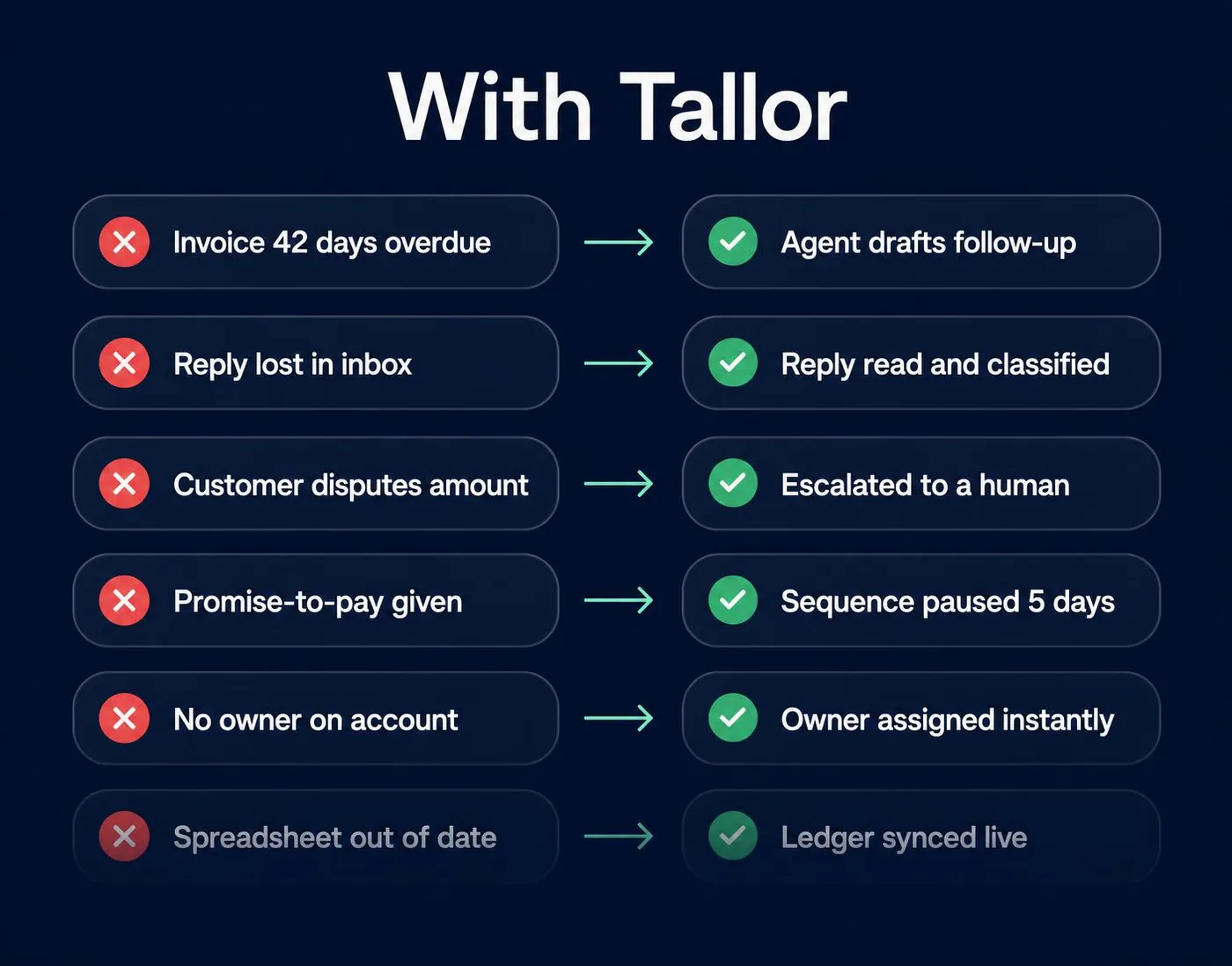
Paired rows showing each missed invoice signal resolved by an action with Tallor
Every signal maps to an action, and a human sees only the exceptions.

Two invoices. Same amount, same age. One pays itself, the other never will.

On any aging report these are the same row, because age is the only thing it knows. One of them is approved and scheduled. The other never reached a person at all. Telling them apart is the difference between collecting the money and writing it off.

Aging report

Two overdue invoices exactly as an aging report shows them
InvoiceCustomerBalanceAge
INV-2041Ashgrove Partners$37,00060+ days
INV-2088Halden & Co$37,00060+ days

INV-2041

Sitting in accounts payable

ap@ashgrove.example

“Approved on our side. It is scheduled for Thursday's payment run.”

What Tallor recorded
Promise recorded, 14 Aug
Reminders paused until then

Wait. A third reminder here costs you the relationship and collects nothing.
INV-2088

Never entered their AP system

j.mercer@halden.example

Delivery failed. 550 5.1.1, recipient address rejected.

What Tallor recorded
Bounced 8 weeks ago
No working contact on file

Call today. Every week this ages, the odds of collecting it fall.

How old a debt is tells you almost nothing about whether it will be paid.

Three questions, three screens, no spreadsheet.

What is stuck and why, whether payroll clears, and exactly how much the agent is allowed to do on its own.

Receivables

Which accounts do I pick up the phone for?

An aging report knows one thing, how old a debt is. This adds the second dimension: why it has not been paid. Silence is the most common reason and the one nobody catches, because an invoice that nobody followed up on never raises its hand.

Two causes account for almost everything past sixty days, and both of them need a person rather than another reminder.
Overdue balance by cause and aging band, sample workspace
Why it is stuck1–3031–6061–9090+
Silent after remindersneeds a personEscalate to a person$1,840$3,120$2,980$1,240
In conversationWork the review queue$3,300$1,150nonenone
Promised a dateWait, then follow up if it slips$2,900nonenonenone
Says it is paidVerify against the provider$1,120$940nonenone
DisputedResolve it, chasing will not collectnone$1,240nonenone
Address bouncedneeds a personGet a working addressnone$680$740$1,180
$22,430 overdueunder $1,000$3,000+

Cash flow

Will payroll clear?

Ninety days of projected cash, weighted by how your customers actually pay rather than by what the due dates claim, with your obligations sitting on top of it.

$40k$20k$0−$10ktodayday 30day 60day 90PayrollQuarterly taxPayrollShort on day 47

Solid where the curve is graded against invoices this workspace has actually settled. Dashed past day 30, where it is directional.

Excluded and counted: 2 invoices with no due date, and $1,240 disputed.

Projected cash balance by day
DayProjected balance
0$41,300
7$43,900
14$20,100
21$24,600
28$29,900
30$31,100
35$22,800
40$15,600
44−$8,900
47−$11,200
52−$4,300
58$3,100
66$10,400
76$18,200
90$28,600

Connections and policy

What goes out tonight without me reading it?

Every draft meets three gates before it can send, and they run in code rather than as an instruction in a prompt.

Ashgrove Partners

INV-2104 · $980

Asked for a copy of the invoice, at 0.97 confidence.

  1. Amountat or under $1,000
  2. Confidenceat or above 0.95
  3. Disputeno dispute flag

Sent, with the invoice attached

Halcyon Media

INV-2039 · $12,400

Says the wire is already sent, at 0.96 confidence.

  1. Amountat or under $1,000
  2. Confidencenot reached
  3. Disputenot reached

Held for you. Over the ceiling

The ceiling is a number you set. It is not a switch you can turn off to go faster.

Figures shown throughout are from a sample workspace.

A three minute tour of what the agent actually does.

A narrated walkthrough of the real product, recorded in a live workspace: the ledger it works from, what counts as a payment, reminders sent from your own mailbox, the gates every message clears, and the controls that stay yours. Turn the sound on, or read the captions.

app.tallor.io/the-problemnarrated walkthrough
Tallor product walkthrough preview

The problem · The weekly chase, rebuilt every Monday

Four reminders, then it hands the invoice back to you.

The three nudges before the due date are optional and off until you switch them on. Everything after it escalates in wording and never in threat.

Before the due date, courtesyAfter it, recovery
  1. −7dCourtesy note
  2. −3dHeads-up
  3. −1dDue tomorrow
  4. DuePayment date
  5. +1dFriendly reminder
  6. +7dFollow-up
  7. +14dFirm reminder
  8. +21dFinal notice
+1dFriendly reminder

finance@northwind.io

Invoice 1042, payment link inside

Hi Sarah, I think this one may have slipped past. The link below settles it in a click if that helps.

+7dFollow-up

finance@northwind.io

Invoice 1042, 7 days outstanding

Following up on $4,800, outstanding since 14 July. Happy to resend the PDF if it went astray.

+14dFirm reminder

finance@northwind.io

Invoice 1042, 14 days overdue

Could you let me know a date we can expect this to be paid? Glad to work around your payment run.

+21dFinal notice

finance@northwind.io

Invoice 1042, final notice

This is the last automated message on this invoice. Someone from our team will follow up with you directly.

There is no legal-threat template, no late fees and no collections agency. Past the final notice the next useful action is a human one, so the engine stops and says so.

The collections runtime, end to end.

If you own the integration or the risk review, this is the whole system: nine components that turn an overdue invoice into collected cash. Scroll the path and each stage lights up as the agent hands off to the next. Not needed to buy, only to trust.

  1. 01 · Ingest

    Your ledger becomes the source of truth

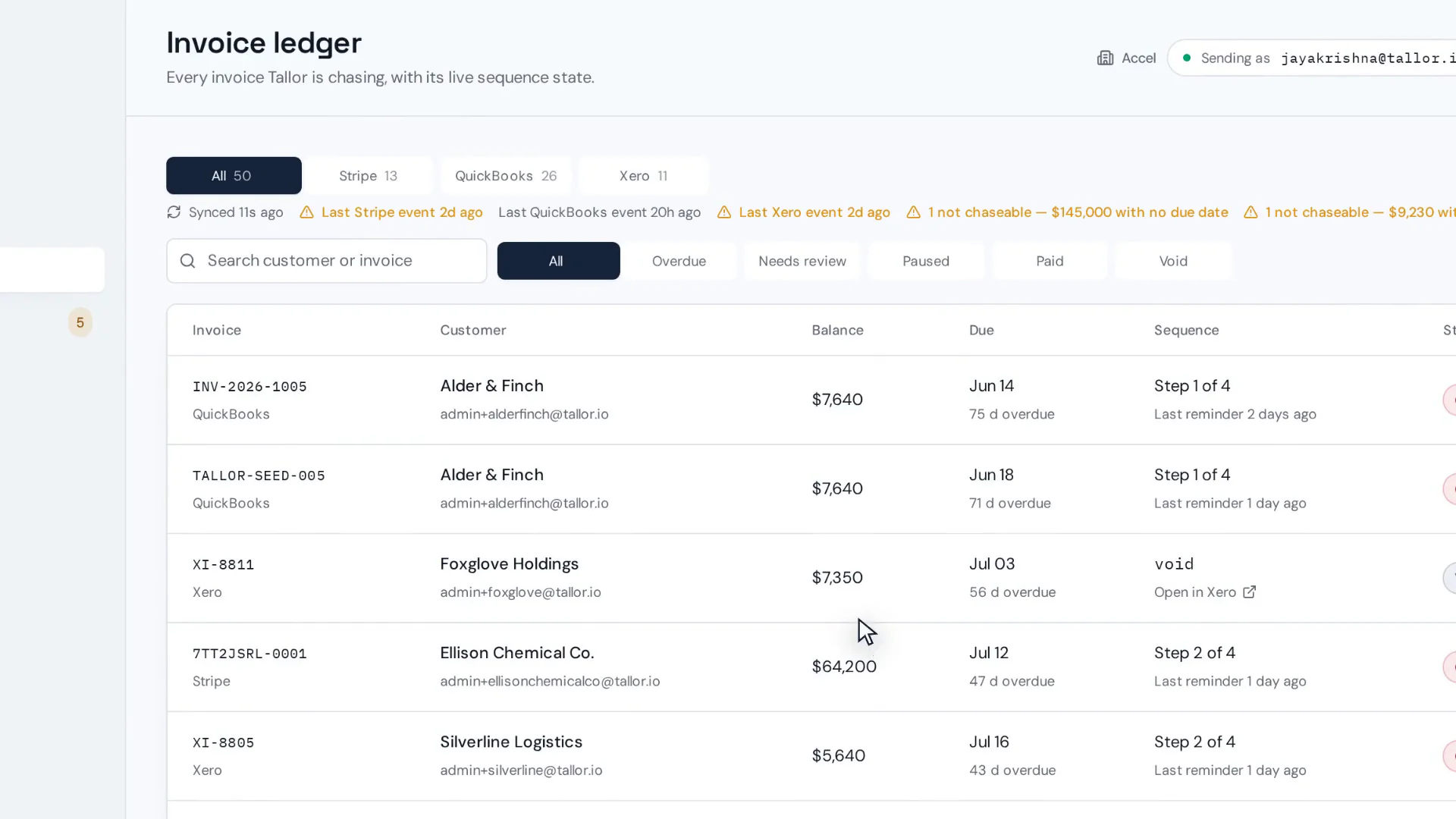
    Stripe and QuickBooks connect with read-only scopes. Tallor pulls open invoices, balances and billing contacts on first sync, then keeps them current on every webhook, so the agent never chases an invoice that has already been paid.

    • read-only scopes
    • webhook-driven
    • 10 min setup
  2. 02 · Model

    One AR graph per customer, not a list of emails

    Invoices, ageing buckets, prior promises-to-pay, payment history and the right contact are normalised into a single account view. Every downstream decision reads from this graph, which is why drafts reference the correct amount, date and PO.

    • ageing buckets
    • contact resolution
    • payment history
  3. 03 · Schedule

    Durable sequences that sleep for days and wake on time

    Each overdue invoice gets a sequence on the published cadence: day 1, day 7, day 14, day 21. Timers are durable, so a deploy, restart or outage never drops a follow-up and never double-sends one.

    • exactly-once sends
    • your cadence
    • instant cancel on payment
  4. 04 · Draft

    Drafts grounded in the invoice, not in vibes

    The composer writes from retrieved facts: amount outstanding, days late, thread history and tone for that stage. No invented figures and no invented dates. Every claim in the email traces back to a ledger field.

    • fact-grounded
    • stage-aware tone
    • thread continuity
  5. 05 · Govern

    Three gates run in code before anything leaves

    Amount ceiling, confidence floor and intent policy are evaluated deterministically in code, not by the model. An invoice above your ceiling, a classification under 0.95, or a dispute intent stops the send and opens a review item instead.

    • amount ceiling
    • confidence ≥ 0.95
    • intent allow-list
  6. 06 · Send

    It goes out from your finance inbox

    Delivery uses your own Google Workspace identity, so replies land in the thread your customer already knows and your domain reputation stays yours. If the OAuth token is ever revoked, sending pauses and the status pill asks you to reconnect.

    • your domain
    • real threads
    • fail-safe pause
  7. 07 · Understand

    Every reply is classified before it is acted on

    Inbound mail is read for intent, with a confidence score attached: promise to pay, wire claim, invoice request, dispute, out-of-office. Reconciled payments cancel the sequence instantly, ahead of any scheduled follow-up.

    • 6 intents
    • confidence scored
    • payment cancels sequence
  8. 08 · Resolve

    Routine outcomes close themselves, edge cases reach you

    Most replies resolve without a person: the agent acknowledges, reschedules or closes the sequence. Disputes, wire claims and anything low-confidence route to the review queue with the draft, the gate results and the full decision log attached.

    • routine closes itself
    • one queue for exceptions
    • every action logged
agent runtimestage 01/08

tap a node to jump to its stage

An agent that keeps a record of everything it did.

Autonomy is a setting, not a promise. You choose the amount ceiling, the escalation cap and which intents always require a person.

Read-only ledger scopes

01

Stripe and QuickBooks connect with the narrowest scopes that still let us reconcile an invoice. Tallor can read your ledger; it can never move money in it.

Line illustration of a laptop connected to a locked padlock beside a read-only ledger

Policy gates before every send

02

Amount ceilings, tone limits and escalation caps are enforced in code, not in a prompt. Every gate has to pass before an email leaves your inbox.

Line illustration of a person reviewing a checklist with a shield before an email is sent

Fails safe, never silent

03

If OAuth expires, a reply looks ambiguous or a gate fails, the sequence stops and tells you. The agent never guesses its way through an edge case.

Line illustration of a person raising a hand to pause an automated sequence with an alert bell

What Tallor will not do.

Tallor emails your customers from your address. That is the point of it, and it is also the risk, so the limits are specific rather than reassuring noises.

It is probably not for you if

you already run a collections process with owners and escalation paths. Tallor exists to be the process you do not have. If you have one, you want something that plugs into it, and this is not that.

No debtor portal
Your customers do not get another login to forget. Everything happens in the email thread they already have.
No un-gated sending
The amount ceiling and the confidence floor are not settings you can switch off to go faster. They run on every draft.
No aggressive escalation
The sequence ends at the final notice and hands over to you. There is no legal-threat template to reach for.
No bank-feed scraping
No Slack bot either, and no automated PDF chasing letters. Read-only ledger access is the whole of what Tallor takes.
No status that does nothing
Overdue, needs review, paused, paid, void. Five, not fifteen. A status that changes nothing the engine does is clutter on a filter row.
No cut of what you collect
You are billed for the software. Charging a percentage of money you were already owed is what a collections agency does.

What is getting paid ten days sooner worth to you?

Late payment costs the average business around $40,000 a year. Seventeen per cent of small business owners have missed or nearly missed payroll over it, and twenty-nine per cent have delayed paying themselves. None of those is the number that decides anything. This one is.

$2,400,000
52 days
10 days
12%

Daily revenue is annual revenue over 365. Cut your DSO by a day and you release one day of it, once, and keep it. The annual figure applies your cost of capital to what comes back.

Released once, and kept

$65,753

Today’s receivables19% released
Still tied up
releasedReleased
52 days today42 days after
Tied up in receivables today
$341,918
What that capital earns back a year
$7,890
Where your DSO lands
42 days

That is money you already earned, so you never raise it, never dilute for it and never pay interest on it.

The real cost of late payments, 2025. Bluevine, The Reality of Owning a Small Business, 2026.

Pricing that follows the invoices, not the seats.

Start free on ten invoices. Paid plans turn on automated sending and scale with how much receivable you carry, never with how many people log in.

Annual is ten months’ money for twelve.

Picking a cadence here only changes the price shown. The trial takes no card, so you choose monthly or annual later in billing, and either way a plan's limits are identical.

Free

$0forever

10 invoices

chased at a time

You want to see what is stuck before you let anything send.

Start free
Mailboxes
1
Ledger connections
1
Cash-flow forecast
Not included
Automated sending
Not included

Starter

$149per month

150 invoices

chased at a time

You invoice a few times a week and nobody chases them.

Start 21-day trial
Mailboxes
1
Ledger connections
1
Cash-flow forecast
Not included
Automated sending
Included

Growth

Recommended
$349per month

750 invoices

chased at a time

You invoice daily and need to know whether payroll clears.

Start 21-day trial
Mailboxes
3
Ledger connections
3
Cash-flow forecast
Included
Automated sending
Included

Scale

$749per month

Unlimited

no cap on chasing

More than one entity, more than one mailbox, no ceiling.

Book a demo
Mailboxes
99
Ledger connections
3
Cash-flow forecast
Included
Automated sending
Included

On every plan, Free included

  • Sends from your own mailbox, never ours
  • Every reply read, classified and drafted
  • Nothing over $1,000 goes out without you
  • Full audit trail of every decision
  • Your workspace isolated at the database level

What counts as an active invoice?

One that Tallor is currently chasing. Paid, void and paused invoices do not count against the number, and neither does anything you have told it to leave alone.

What happens if I go over the cap?

Nothing breaks and nothing is deleted. The oldest overdue invoices are prioritised, the rest wait, and the workspace says so rather than quietly stopping.

What happens when the trial ends?

After 21 days you drop to Free. Your ledger, your history and the receivables view stay exactly where they are. Sending pauses until you pick a plan.

Can I cancel?

Yes, through the payment portal. Your workspace keeps running until the end of the period you have already paid for.

Do you take a cut of what I collect?

No. You pay for the software and nothing else. Charging a percentage of your own receivables is how a collections agency prices, and Tallor is not one.

No card to start. Twenty-one days on Starter and Growth, which is exactly one full sequence, from the first reminder to the final notice, and when it ends you drop to Free rather than losing anything. Scale is set up with us directly.

Prices in USD, excluding tax. VAT and sales tax are calculated at checkout by Dodo Payments, our merchant of record.

The questions everyone asks first

The six that come up before anyone lets software email their customers. Anything deeper is a better conversation than a paragraph.

Ask us live

Yours. Reminders go out through your own Google Workspace as finance@yourcompany.com, so they land in the inbox rather than the promotions tab, replies come back to a thread your customer recognises, and a forward for internal approval looks like it came from a supplier, because it did.

Three checks run on every draft, in code rather than in a prompt. An invoice over $1,000 is never answered without you, neither is anything the classifier is less than 95% confident about, and neither is anything that looks like a dispute. Any one of them failing routes the draft to your review queue instead of sending it.

Before any reminder goes out Tallor checks whether the invoice is paid, void or at zero balance, whether a promised date has not yet arrived, whether a reply is sitting unanswered in your queue, whether the address has bounced, and whether the customer asked to stop. It also polls each ledger hourly and reconciles, so a dropped webhook cannot freeze the picture it is working from.

They stop hearing from you immediately, without waiting for you to approve it. Every other decision here waits for a human and this one deliberately does not. Getting it wrong leaves one invoice unchased, visibly paused and one click to undo. Getting it slow sends another reminder to somebody who asked to be left alone.

Yes, once, for about five minutes. Sending from your real domain needs a Workspace admin to authorise Tallor's service account, and the screen shows exactly which client ID and scopes to paste. It is not one click and we would rather say so than pretend otherwise.

No. Every workspace is isolated at the database level rather than by application code that could forget, and nothing about your customers reaches analytics: no name, no email address, no invoice number, no line of drafted copy.

Get paid 21 days sooner, without hiring a collections team.

Connect your ledger, review the first few drafts, then let Tallor take the routine chasing off your desk.